Independent thermal, mechanical and acoustic testing for cooling towers — verifying performance, efficiency and compliance across Saudi Arabia and the GCC.
Cooling towers play a critical role in the heat rejection cycle of industrial and commercial facilities, yet their thermal performance can degrade gradually and go unnoticed until efficiency losses become costly. Green Vertex delivers independent cooling tower testing — combining thermal performance evaluation, drift and noise testing, and mechanical condition inspection — to confirm towers are performing as designed and operating safely across Saudi Arabia and the GCC.
Whether verifying a newly commissioned tower against contractual performance guarantees or diagnosing declining efficiency in an older unit, our engineers apply internationally recognized test methods to translate field conditions into design-equivalent performance data, giving facility managers the evidence needed for informed operational and investment decisions.
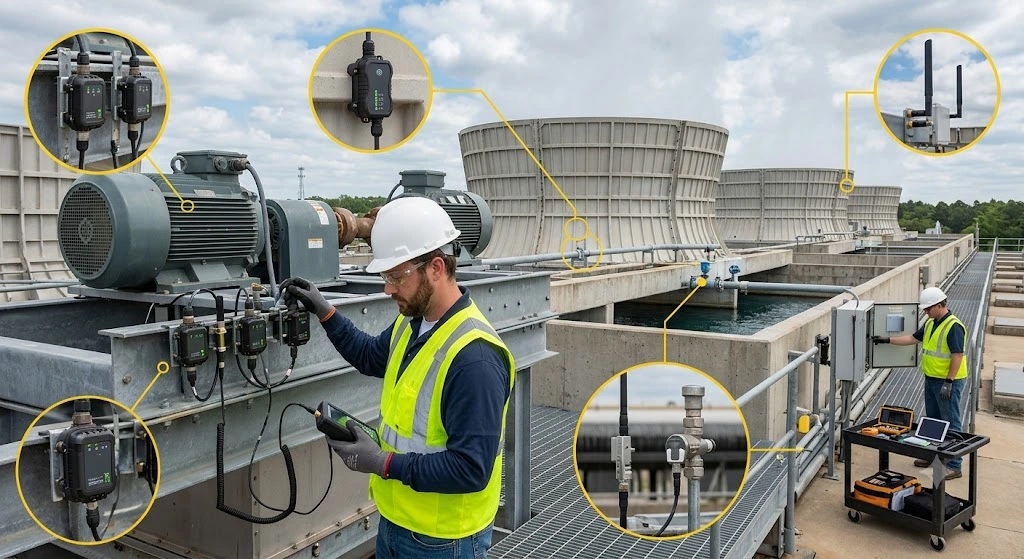
Field verification of cooling tower heat rejection capacity against design water flow, heat load and inlet wet-bulb conditions, translating off-design results into design-equivalent performance.
Independent acceptance testing at commissioning to confirm a newly installed cooling tower meets contracted performance guarantees before final handover and payment.
Diagnostic testing for aging cooling towers experiencing declining efficiency, providing the data needed to evaluate repair, refurbishment or replacement options.
Measurement of drift carryover and associated particulate emissions from cooling towers to support accurate air permit reporting and regulatory compliance.
Near-field and worker-exposure noise measurement around cooling tower fans and structures, identifying and helping manage occupational noise hazards.
Structural, fill, drift eliminator and fan system inspection identifying wear, damage or efficiency losses affecting cooling tower operation.
Review the site, facility or project and confirm objectives and applicable regulatory requirements.
Develop a project-specific methodology, schedule and quality assurance plan.
Mobilize qualified specialists and calibrated equipment to site or to the desk-based study.
Carry out field work, testing, sampling or engineering review in line with the agreed plan.
Validate raw data and results through structured QA/QC checks.
Interpret findings against applicable standards, limits and benchmarks.
Discuss preliminary findings with your team and refine conclusions where needed.
Prepare a clear, regulator-ready report with findings, evidence and recommendations.
Support implementation of recommendations and respond to regulator or client queries.